History of Blockchain
Evolution of Blockchain Technology
Blockchain, at its core, is a chain of blocks — a continuously growing digital ledger that records transactions in a secure, chronological, and immutable manner. Once a block is filled with data, it is permanently linked to the previous block, forming a chain. Over the decades, blockchain evolved from a cryptographic idea into one of the most transformative technologies of the modern era.
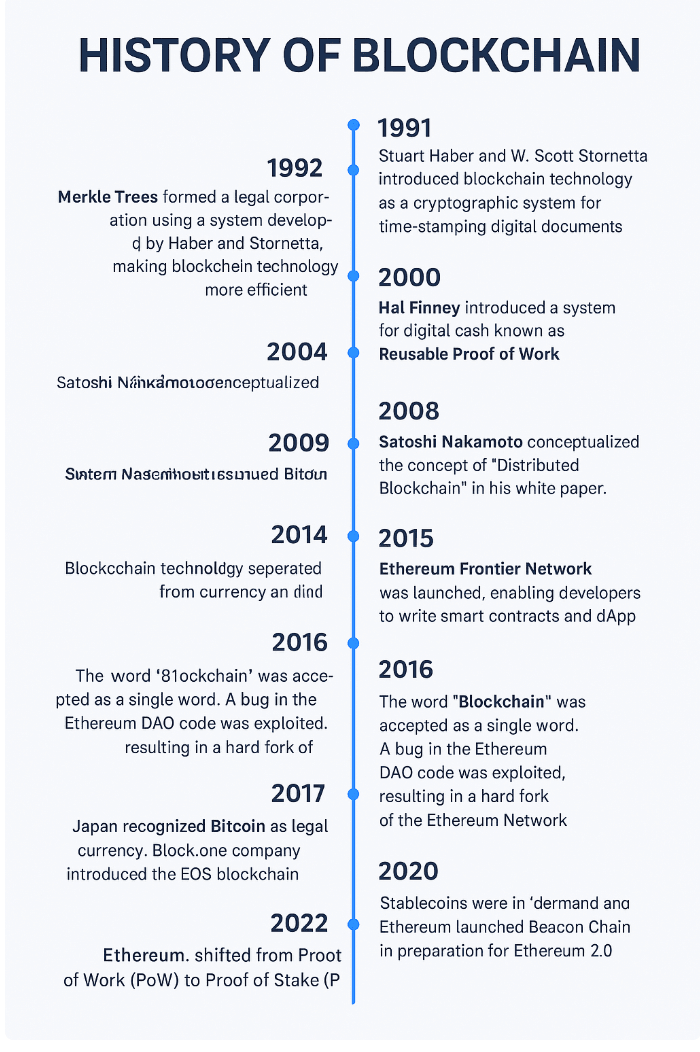
1991 – The Beginning of Time-Stamping
In 1991, researchers Stuart Haber and W. Scott Stornetta introduced a cryptographic method to time-stamp digital documents so they could not be altered or backdated. Their idea was to link documents together using cryptographic hashes, forming the early structure of what we now call blockchain.
1992 – Introduction of Merkle Trees
In 1992, Merkle Trees were introduced to improve efficiency. This allowed multiple documents to be grouped inside a single block, improving scalability and verification speed. Despite this innovation, the technology remained mostly academic for several years.
2000 – Cryptographically Secured Chains
Around 2000, Stefan Konst published work describing cryptographically secured chains and discussed practical implementation methods. His contributions helped shape the theoretical framework for distributed ledger systems.
2004 – Reusable Proof of Work
In 2004, Hal Finney developed Reusable Proof of Work (RPoW), a system designed to prevent double spending in digital currencies. This marked an important milestone toward decentralized digital money.
2008 – Bitcoin Whitepaper
In 2008, Satoshi Nakamoto published the whitepaper titled “Bitcoin: A Peer-to-Peer Electronic Cash System.” The paper proposed a decentralized blockchain secured by proof-of-work, eliminating the need for a central authority while ensuring trust and immutability.
2009 – Launch of Bitcoin
In 2009, Bitcoin was launched as the first real-world blockchain application. It demonstrated how decentralized networks could securely record financial transactions. Mining began during this period, introducing incentives for maintaining the network.
2014 – Blockchain Beyond Cryptocurrency
By 2014, industries began exploring blockchain beyond digital currency. Often referred to as Blockchain 2.0, this era saw applications in supply chains, finance, healthcare, and governance systems.
2015 – Smart Contracts and Enterprise Adoption
In 2015, the Ethereum Frontier Network launched, introducing smart contracts and decentralized applications (dApps). The same year, the Linux Foundation introduced the Hyperledger Project to support enterprise-grade blockchain solutions.
2016 – Security Challenges
The year 2016 brought challenges, including the Ethereum DAO vulnerability, which resulted in a network split (hard fork). Security incidents highlighted the importance of smart contract auditing and governance mechanisms.
2017 – Global Recognition
In 2017, Bitcoin gained wider global acceptance, including legal recognition in some countries. Blockchain platforms such as EOS were introduced to improve scalability and commercial use cases.
2018 – Market Volatility and Regulation
In 2018, Bitcoin completed a decade since its proposal. However, market volatility and concerns about scams led to increased regulatory attention and advertising restrictions from major technology platforms.
2019 – Enterprise Blockchain Services
In 2019, enterprise blockchain adoption accelerated. Services such as Amazon Managed Blockchain enabled businesses to deploy scalable distributed ledger networks more easily.
2020 – Stablecoins and Ethereum 2.0
Stablecoins gained popularity due to reduced volatility compared to cryptocurrencies. Ethereum launched the Beacon Chain, initiating its transition toward Ethereum 2.0 and proof-of-stake consensus.
2022 – The Merge
In 2022, Ethereum completed “The Merge,” transitioning from proof-of-work (PoW) to proof-of-stake (PoS). This significantly reduced energy consumption and marked one of the most important upgrades in blockchain history.
Conclusion
From a cryptographic time-stamping system in the early 1990s to a global decentralized infrastructure powering finance, smart contracts, and enterprise applications, blockchain technology continues to evolve. Its journey reflects innovation, experimentation, challenges, and rapid adoption across industries worldwide.
Test Your Knowledge
Practice what you've learned with these quizzes related to What is Blockchain?.
Continue Learning
Explore more topics in What is Blockchain? or browse other tutorials.