Trade-offs: scalability vs. security vs. decentralization (Blockchain Trilemma)
The Blockchain Trilemma, proposed by Ethereum co-founder Vitalik Buterin, highlights the challenge that a blockchain cannot maximize scalability, security, and decentralization all at the same time. Typically, a blockchain must sacrifice one of these three pillars to strengthen the other two.
1. Security
- Security ensures the blockchain is resistant to attacks (like double spending, Sybil attacks, or 51% attacks).
- A highly secure blockchain makes it costly and nearly impossible for malicious actors to alter transactions.
2. Decentralization
- Decentralization means no single authority controls the system — power is distributed among many nodes.
- It provides transparency, censorship resistance, and trustless operation.
3. Scalability
- Scalability is the ability to handle a large number of transactions per second (TPS) efficiently.
- A scalable blockchain supports mass adoption for payments, DeFi, gaming, and IoT.
The Trade-offs (Why it’s a Trilemma)
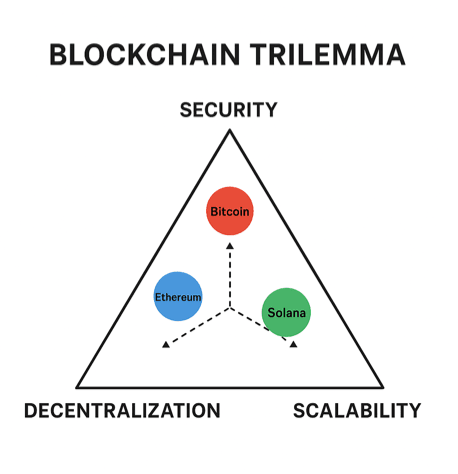
- Security + Decentralization → Sacrifices Scalability
- Example: Bitcoin and Ethereum (before Layer-2 solutions). They are secure and decentralized but slow (limited TPS).
- Scalability + Security → Sacrifices Decentralization
- Example: Permissioned blockchains like Hyperledger. They are fast and secure but rely on a few validators (less decentralized).
- Scalability + Decentralization → Sacrifices Security
- Example: Some newer blockchains prioritize speed and openness but risk lower security against sophisticated attacks.
Visual Triangle (Conceptual)
            Decentralization
                 ▲
                 |
                 |
 Security ◄──────┼──────► Scalability
Blockchain projects often place themselves closer to two corners and away from the third.
Summary
The Blockchain Trilemma shows that no blockchain perfectly balances security, scalability, and decentralization. Different consensus mechanisms and designs optimize for two while compromising on the third. Future innovations like Layer-2 scaling (rollups, channels), sharding, and zero-knowledge proofs aim to overcome this limitation.
Continue Learning
Explore more topics in Consensus Mechanisms in Blockchain or browse other tutorials.